

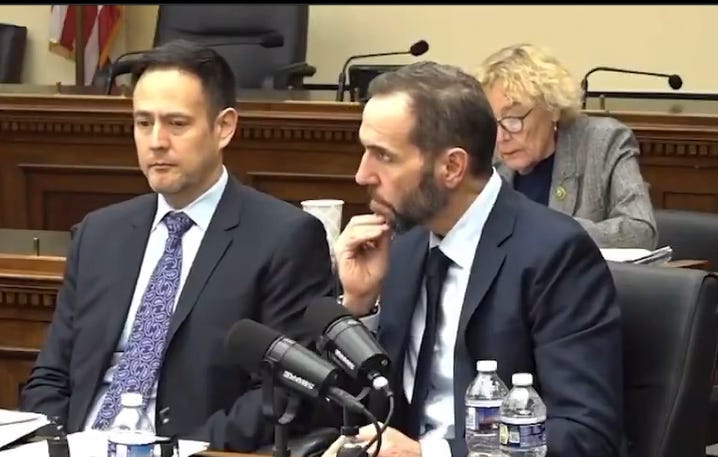
Special Counsel Jack Smith and President Donald Trump have agreed on one thing over the past few years—the need for Smith’s public, sworn testimony before the American people about his work as special counsel.
That mutual wish comes true on Thursday when Smith testifies for a second time before the House Judiciary Committee; Smith sat for a transcribed interview in December, however, that appearance occurred behind closed doors. Now Smith, who ironically argued vociferously against the use of cameras in the courtroom during the president’s potential trial in Washington (which never took place obviously), finally will get his requested spot in the Congressional limelight.
Never short on swagger, self-righteousness, and unjustified arrogance given his track record, Smith likely believes he can easily charm the crowd with his deep knowledge of the two unprecedented criminal cases he brought against Trump in 2023—one related to the events of January 6 and the other related to the president’s alleged mishandling of classified documents—and make the closing arguments he never made in court since both matters were dropped after Trump won the presidential election.
While much of the media swooned over Smith’s eight-hour performance—the committee on December 31 released the transcript and the video recording of his interview—not everyone was dazzled by the grizzled ex-war crimes prosecutor. None other than the Washington Post editorial board recently slammed Smith’s answers about the First Amendment implications of his Jan. 6 case, which included a gag order on Trump and his associates during the 2024 campaign season. (The special counsel unsuccessfully sought a similar order in the documents case.)
Smith, the WashPo board correctly surmised, was “still clinging to flawed legal theories,” had “[lost] sight of constitutional limits,” and “seemed unconcerned about interfering in the democratic process by seeking to muzzle a candidate for high office.”
The board took direct aim at Smith’s retort that the president’s statements about voting fraud were “absolutely not” protected by the First Amendment. “Political speech — including speech about elections, no matter how odious — is strongly protected by the First Amendment. It’s not unusual for politicians to take factual liberties. The main check on such misdirection is public scrutiny, not criminal prosecution. The former special counsel apparently has no regrets about this heavy-handed approach, even though it failed legally and probably helped Trump win the 2024 election.”
And it is that overall heavy-handed approach, an overly nice way to describe the special counsel office’s egregious misconduct in both cases, that requires a deep drilling-down by Republicans on the committee.
Much More to Smith’s Unlawfulness than the Pursuit of Congressional Phone Records
Yes, Smith’s subpoenas for the cell records of several GOP senators and accompanying court-authorized nondisclosure orders represent an appalling breach of the law and Constitutional boundaries, but his office’s overall malfeasance as it pursued the real victim here, Donald Trump, demands a full public vetting.
After all, one can only conjure up so much sympathy for members of Congress whose privacy rights were violated by the Biden Department of Justice when many of those same members remained silent as the DOJ did the same, far worse, to their own constituents for four years.
To that end, Republicans should shorten lines of inquiries about the cell phone subpoenas and instead ask Smith to explain other examples of his lawlessness, dishonesty, and downright incompetence. My top ten list:
(1) Judge Aileen Cannon dismissed the classified documents indictment in July 2024 after determining your appointment violated the Appointments Clause of the Constitution but you continued to sign your name on court filings in that matter until the time you resigned from office in January 2025. On what basis did you continue to add “Special Counsel Jack Smith” on briefs and motions after Cannon disqualified you? A federal judge this week stated that a prosecutor who continues to sign his name to court filings after a disqualification order should face disciplinary action and/or disbarment. Do you agree?
(2) The Department of Justice conducted the initial stage of the documents investigation in Washington D.C. although the proper jurisdiction was southern Florida where the alleged crimes occurred. You continued that approach after you were appointed in November 2022, only to switch to southern Florida at the last minute to secure an indictment. How did you present all the case materials to a grand jury in Florida?
(3) Did you keep the documents case in Washington to obtain favorable rulings by Chief Judges Beryl Howell and Jeb Boasberg, both Obama appointees, such as the extraordinary step of piercing attorney client privilege between the president and his lawyer as well as subpoenaing the president’s Twitter data without his knowledge in clear violation of executive privilege protections?
(4) Speaking of, why did you initially claim the president would “flee from prosecution” if he was informed about the subpoena as a way to secure the nondisclosure order?
(5) You also said in your December interview that Twitter “refused to comply even after [Judge Howell] ruled.” But that is not true. Not only did Twitter comply while at the same time fight the nondisclosure order, four judges on the D.C. appellate court later condemned your request—and Howell’s participation in the “unprecedented search,” as they described it—as having “obscured and bypassed any assertion of executive privilege.” Who authorized such an historic breach of presidential privilege?
(6) Attorney General Merrick Garland appointed you as a sign of “independence” from the Biden DOJ. However, your December testimony revealed you actively sought a position at the DOJ beginning in the summer of 2022, months before you were appointed. This effort consisted of conversations with Deputy Attorney General Lisa Monaco, her chief deputy, and others. You further stated that you wanted to work in the DOJ’s new “domestic terror unit,” which had recently been created by your former Obama DOJ colleague Matthew Olsen, head of the national security division at the time. That new unit, and Olsen, were actively involved in the criminal investigation into the president and his supporters as part of the overall Jan 6 investigation. Are you saying you did not actively seek a DOJ position to help investigate and eventually prosecute the president?
(7) In your opening statement to the committee last month, you claimed to have proof that the president retained highly classified documents in “a ballroom and a bathroom” at Mar-a-Lago. But you had no way of knowing whether any of the documents your office eventually obtained had been stored in boxes in either location, correct?
(8) You have also stated publicly and in your indictment that the president “repeatedly tried to obstruct justice” in the documents investigation. But that allegation not only contradicts the facts--the president and his team had been fully cooperating with the government even allowing a top DOJ prosecutor and three FBI agents to voluntarily search Mar-a-Lago in June 2022, telling the group he would help with “whatever they need”--but also internal struggles within the DOJ as to the need for a raid. Isn’t it true the president was not obstructing the inquiry and instead was in fact cooperating with every request?
(9) Did you have any concerns during the course of your investigation that FBI agents brought colored classified cover sheets to the Mar-a-Lago raid, attached those cover sheets to files seized during the raid, and took a photo as a publicity stunt to make it look like the files had been found in that condition?
(10) In the course of 14 months, your office spent at least $50 million in tax dollars on your investigations. On what?
There are plenty of other scandals for committee members to pursue—Smith’s use of at least one FBI informant in the “Arctic Frost” investigation; allegations of prosecutorial misconduct by Jay Bratt, his lead in the documents case; how quickly Smith returned the exact same J6 indictment in Washington just a few weeks after the Supreme Court ruled on presidential immunity; his team’s misrepresentations to Cannon about the condition of evidence—but the questions above should get to the heart of Smith’s corruption.
Jack Smith, enter stage left.
Great questions list, Julie! I wish so much you could do the questioning of Smith (might have to hold your nose while you do!), because no one knows these cases better than you. I hope the committee takes your advice and asks the right questions and doesn’t let Smith slither away from accountability. This should be fun. I’ll make the 🍿😆
It would be helpful if the Republican clowns doing the interogatives actually asked a question of this freak of nature instead of bloviating about themselves. This reptilian representation of a human form should be strapped naked to a chair in a very cold room, have cold water dumped on his head and left for a good half hour to contemplate whether he wants to give honest answers. We get some where at that point…otherwise this is just another show trial run by the other party…