

Last year, the international sports world sat on edge for weeks waiting for Alexander Ovechkin, captain of the Washington Nationals professional hockey team, to surpass the all-time scoring record held for 26 years by Wayne Gretzky, nicknamed “The Great One.” When Ovechkin scored his 895th goal on April 6, 2025, hockey fans and sports enthusiasts around the world cheered the Russian’s history-making achievement; the National Hockey League proclaimed in a social media post the “passing of the torch” from Ovechkin to Gretzky, a consummate gentleman and sportsman who had attended the game to watch the moment in real time.
Commentators did not question whether Ovechkin should have received such glowing accolades as his homeland continued to attack Ukraine in a conflict Russia initiated in 2022. Competitors and teammates did not refuse to shake his hand over the war—or over his personal relationship with Russian President Vladimir Putin, whom he calls “my president.” (Ovechkin’s Instagram profile photo is of himself and Putin.) To the contrary, athletes and celebrities fawned over Ovechkin’s feat in a video montage. “I’m very happy for you,” said tennis great Roger Federer, who won the men’s Roland Garros title in 2009. “I hope you can hold the record forever.”
There is no indication, however, that Federer has offered a word of congratulations to Mirra Andreeva, the Russian teenager who won the women’s title at Roland Garros last weekend. Not only was Andreeva, 19, denied anything close to the Ovechkin treatment by her colleagues, celebrities, and the sports media, she was snubbed by her Ukrainian competitors and tournament organizers in general.
Sniping over the war proved as problematic for the prestigious two-week tournament, considered one of the four “Grand Slams” in tennis, as the withdrawal of fan favorite Carlos Alcarez and the early exit by top-ranked men’s player Jannik Sinner—and the tension appears contained to the women’s side since seven of the top 20 women’s players are of either Russian or Ukrainian descent. (I can’t find any evidence of men tennis players refusing to shake the hand of Russia’s Danill Medvedev, the 8th ranked men’s player in the world.)
It represents an ongoing cat fight that has no place in professional sports.
And How Exactly Will This End the War?
Following a policy enacted by each professional tennis organization shortly after the start of the war in 2022, the Russian flag could not be displayed next to the name of Russian players, including Belarus-born Aryna Sabalenka, the world’s number one women’s player, during any Roland Garros broadcast. (This is true of every televised tennis tournament.) Displaying the Russian flag is verboten on professional tennis websites; during Andreeva’s trophy-winning match at Court Philippe-Chatrier in Paris on Saturday, stadium officials seized Russian flags being waved by a few spectators.
After her decisive victory, the French Tennis Federation refused to play Andreeva’s national anthem, a tradition at Roland Garros, to honor the Russian’s achievement. (She is the first teen to win the tournament since Monica Seles in 1992.) And so far, Novak Djokovic and Maria Sharapova are the only tennis greats on record praising Andreeva’s win.
Unfortunately, antics by Ukrainian players continue to threaten the watchability of what is currently one of the most exciting periods in the sport, especially for women players. There is nothing wrong—in fact, it’s entirely appropriate—for an athlete to use his or her stardom to advance a political viewpoint or defend their homeland off the court: donate their winnings, meet with officials in their own government, visit front-line fighters, produce ads blasting the bad guys, plead for peace. All good.
What’s wholly inappropriate is an athlete personally attacking competitors whose only tie to the war is their place of birth. Take, for example, comments made on May 27 by Oleksandra Oliynykova, who suggested Russian-born players are Putin propagandists. (She sounds like a Democratic member of Congress!):
Time for a Warning From the Chair for Unsportsmanlike Conduct
One of the worst offenders is Marta Kostyuk, the Ukrainian-born world ranked #12 who currently lives in Monte Carlo. Similar to Oliynkova, Kostyuk just accused Russian players of aiding the war:
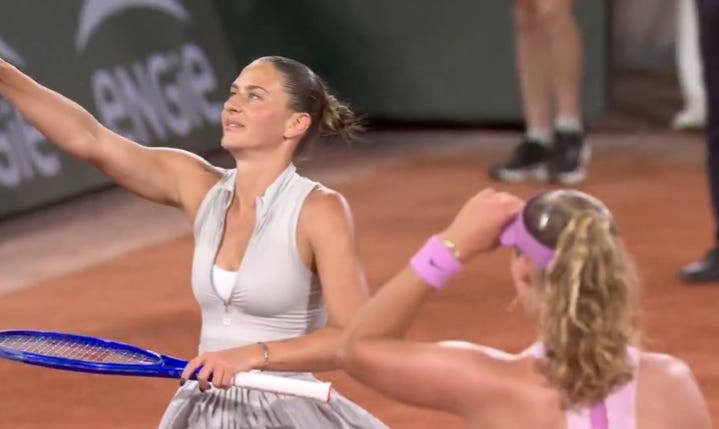
She refuses to shake the hand, another tennis tradition, of any player tied to Russia after a match. After Andreeva beat her in the Roland Garros semi-finals on June 4, Kostyuk walked off the court without acknowledging her opponent.
Kostyuk did the same in Brisbane earlier this year after she beat Andreeva.
In 2022, shortly after the war began, Kostyuk suggested she wanted to “physically” harm her Russian competitors:
The current eight-ranked women’s player in the world, Elina Svitolina, also of Ukraine, is helping fuel the controversy. Svitolina, who also refuses to shake the hands of her Russian opponents, had this to say:
All the drama recently forced Sabalenka, perhaps the most popular player on the tour, to defend herself:
So, what gives? The generous explanation is that Ukrainian (women) players truly want to use their platform to denounce a war with no end in sight. The more sinister explanation is these same players are using the conflict to get into the heads of their fiercest competitors, put Russian players (and others) on the defensive, and poison public sentiment against popular players.
Whatever the case—each tennis organization and tournament should put an end to such antics before the general public switches off. At least the women’s matches.
When the major tournaments resorted to the petty practice of removing the Russian flag next to the names, I started rooting for every single Russian player in any given tournament. Cheering for the spoiler is the reason to tune in if you still enjoy watching Tennis. I’m delighted that Andreeva took the French Open.
The tennis organizations and tournaments should fine the mean Ukrainian girls.