

An horrific crash in Indiana earlier this month brought to the forefront what transportation industry observers warned for years represents an urgent public safety threat on America’s roadways: the proliferation of illegal immigrants and non-English speaking drivers behind the wheel of commercial trucks.
And it’s a danger both President Trump and the Department of Transportation have attempted to address since the early months of the administration—starting with an April 2025 executive order mandating an English-language requirement for commercial motor vehicle drivers—despite interference by one federal court and foot dragging by state licensing agencies.
On February 3, a man from Kyrgyzstan driving a semi-trailer truck crossed into oncoming traffic on State Road 67 near the Ohio border on February 3, killing 50-year-old Henry Eicher, his two sons, Menno (25) and Paul (19), and Simon Gilrod, age 23. All four men were members of the Amish community in Bryant, Indiana.
The driver of the truck, Bekzhan Beishekeev, resides in Philadelphia. He entered the United States in 2023 on the CBP One cell phone app, instituted during the Biden administration, under which nearly one million migrants seeking asylum or “humanitarian” relief crossed the border. (President Trump deactivated the app on his first day in office.)
That deadly collision is the latest in a string of recent high profile wrecks involving illegal immigrant truck drivers; Harjinder Singh, an Indian national here illegally, attempted to perform a U-turn in the middle of the Florida turnpike near Fort Pierce last August, immediately killing three Florida residents traveling in a minivan. Singh subsequently failed an English proficiency test given by investigators after the incident.
From Zero to 200,000 in a Few Years
Both men had obtained what’s called a non-domiciled commercial driver’s license (CDL), which several states issue to foreigners who don’t meet residency requirements but claim various immigration status including asylum. Singh had received a non-domiciled CDL from the state of Washington after flunking the written portion of the test at least ten times, according to reports, and then received an additional CDL from the state of California.
Beishekeev received a non-domiciled CDL from the state of Pennsylvania in 2025, which expired in 2029, a time period longer than it takes to settle most asylum claims. They are currently in ICE custody facing criminal charges and deportation.
“The recent tragic crash in Indiana, which claimed the lives of four innocent individuals, was entirely preventable,” Shannon Everett, co-founder of American Trucker United, told me. “These drivers often lack adequate training, qualification, or thorough vetting under federal standards. Every day that such non-compliant operations are permitted on America’s roadways increases the risk of further devastating incidents and the tragic loss of American families.”
The Federal Motor Carrier Safety Administration (FMCSA), a sub-agency under the Department of Transportation tasked with overseeing trucking safety standards, estimates 200,000 non-domiciled CDLs are in active circulation. (Some states do not track the number of non-domiciled CDLs issued; FMCSA filed a proposal last month that would require all states to “retain all documents involved in the licensing process for non-domiciled CLP and CDL holders for a period of no less than two years.”)
While the initial purpose of a non-domiciled CDL was to allow a U.S. resident with a CDL in one state to apply for a license in another state, several states started extending the offer to foreigners. “This licensing category expanded to include non-U.S. residents, sometimes without proper work permits,” Craig Fuller, the CEO of FreightWaves, a trucking industry data company, wrote in October 2025. “This evolution went beyond the original intent, creating a situation in which licenses were issued to individuals who may not have met all legal requirements for employment in the United States.”
An investigative report based on open records requests to all 50 states by Overdrive, a trucking watchdog website, supports those findings. Every state showed an increase, and in some cases dramatic, in the issuance of non-domiciled CDLs. For example, all of the 1,403 non-domiciled CDLs issued by the state of Indiana in 2025 went to non-U.S. citizens. In Oregon, only 11 non-domiciled CDLs were issued in 2020 but that number rose to 382 in 2024.
FMCSA regulations require a non-domiciled CDL seeker to present an unexpired employment authorization document (EAD) issued by the United States Customs and Immigration Service or an unexpired foreign passport accompanied by an approved I-94 form. Written tests in many states are given in both English and Spanish, however, the field test is federally mandated to be performed in English only. For example, the Texas Department of Public Safety, the licensing agency in that state, offers the written test in both English and Spanish and prohibits the use of interpreters during the driving portion of the exam.
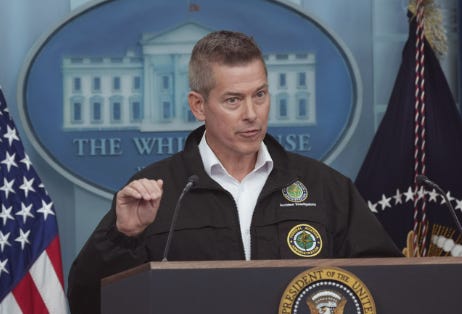
But a multi-state operation last month led by Transportation Secretary Sean Duffy removed from the road at least 500 truckers over a three-day period who failed field proficiency tests, raising questions as to whether states are even following their own rules. Social media videos regularly show truck drivers struggling to understand basic questions from police officers and fellow truckers.
And state licensing agencies are notorious for corruption; last year, law enforcement authorities in Florida exposed a bribery ring that caught DMV employees accepting cash from illegal immigrants in exchange for both commercial and passenger driver’s licenses without taking required tests over a two-year period. The operation involved at least $120,000 in bribes paid to brokers and the DMV employees, who then issued “hundreds, if not at least a thousand” unlawful licenses, Bay County Sheriff Tommy Ford said during a June 2025 press conference announcing the bust. “Putting untested, unqualified drivers, especially those with commercial licenses, on our roads is an unacceptable risk to every family in this state,” Ford said.
Some States and DC Appellate Court Fight to Keep the Status Quo
In response to rising concerns over illegals obtaining CDLs, particularly in the aftermath of the Biden administration’s open border policies, Duffy announced a nationwide “compliance” audit in June 2025. Duffy tasked FMCSA with “[examining] state procedures for issuing non-domiciled CDLs to identify and stop any patterns of abuse and ensure federal standards are being met across the country.”
The results of the audit determined that several states including California, Colorado, Pennsylvania, South Dakota, Texas, and Washington were violating federal law in issuing non-domiciled CDLs; Duffy threatened to withhold federal highway funds for states that refused to come into compliance. The state of California—where an illegal truck driver from India caused a major pile up on a San Bernardino freeway last October, killing three innocents—revoked 17,000 non domiciled CDLs in response to Duffy’s threat.
Duffy announced this week that an audit of the Illinois Secretary of State’s office revealed that at least 20% of all non-domiciled CLDs were issued unlawfully. CDL seekers did not furnish the required documents and some SOS employees issued CDLs that extended beyond the immigrant’s documented work authorization (to the extent those papers were legit.) Illinois has 30 days to come into compliance or risk the loss of $126 million in federal highway funds. Illinois Secretary of State Alexi Giannoulias indicated in a statement that he will challenge the findings.
Duffy also narrowed the category of immigrant workers eligible to receive non domiciled CDLs. In September, he issued an emergency interim final rule in that permitted non-domiciled CDLs only for those holding H-2A agricultural worker visas, H-2B temporary non-agricultural worker visas, or E-2 treaty investor visas. “This interim final rule closes gaps in how states issue CLPs and CDLs to individuals from outside of the United States. It tightens eligibility, strengthens safeguards, and makes clear when these licenses must be canceled or revoked, delivering a more secure system and safer roads for all Americans,” Duffy said in his announcement.
A three-judge panel of the D.C. Circuit Court of Appeals, however, put a hold on Duffy’s proposal in November in response to a petition for review filed by two public employee unions and a DACA owner-operator. While two Democratic appointees downplayed the risks posed by non-domiciled CDL holders, Judge Karen Henderson, appointed by George W. Bush, (a frequent critic of the Trump administration), strongly disagreed with her colleagues’ view. “It should go without saying that our Nation’s roadways are safer the fewer people there are operating eighteen-wheelers, buses and delivery trucks with unchecked driving histories,” Henderson wrote in her dissent. “FMCSA also backed that common-sense proposition with facts, citing five recent fatal crashes caused by foreign-domiciled CDL licensed drivers—three of whom had previously received citations for speeding or failing to obey traffic signals and another who had failed his initial CDL-skills test for similar offenses.”
One can only wonder whether the lives of Henry Eicher, his two sons, and Simon Gilrod would have been spared had the court not intervened to stop immediate implementation of Duffy’s rule.
Regardless, on February 11, Duffy issued a final rule after following the required public comment period, which resulted in at least 8,000 responses. “This rule will ensure no unqualified foreign drivers are able to get a license and operate a big rig — full stop. Now this piece of the puzzle has been addressed, our efforts to crackdown on bad actors, fraudulent carriers, and sham licensing schools that threaten the safety of our roads will only intensify from here,” a DOT spokesman told me via email. It could result in the revocation of nearly all of the estimated 200,000 non-domiciled CDLs in circulation. Absent litigation, which some state officials are already threatening, the rule goes into effect on March 16.
Every time we have a political jurisdiction liberalizing a law, it gives the appearance that our nation has a suicide pact against its own citizens. This trucker's situation is severe enough. And it's all because one political party is fighting to keep every illegal voter in their corner.
It's so difficult to wrap one's head around all of the discovery of incompentence/corruption of the Joebama administration which filtered down to the state levels.
Truly don't know how we recover.