

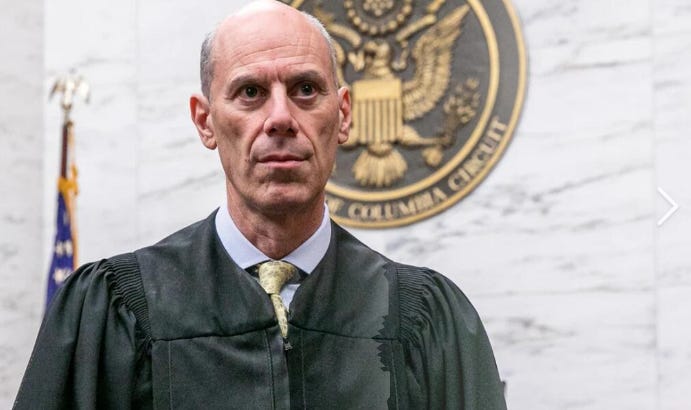
Jeb Boasberg is now the Rory McIlroy of the D.C. Circuit Court—but the Obama appointee won’t receive a green jacket or a lifetime membership at Augusta National.
Instead, Boasberg, the chief judge of the D.C. district court, just earned another black mark on his ignominious judicial record as the winner of back-to-back writs of mandamus related to his 13-month crusade to hold the Trump administration in contempt of court.
In a 2-1 decision handed down on Tuesday, the D.C. appellate court issued its second writ of mandamus to once and for all shut down the contempt investigation that Boasberg opened in March 2025. For more than a year, Boasberg has claimed Trump officials willfully ignored his so-called “oral order” to return two planes carrying more than 100 illegal Venezuelans subject to the Alien Enemies Act, which had been enacted by President Trump on March 15. (My first piece on Boasberg’s contempt trap is here.)
A writ of mandamus “commands” another party—usually a government agency, official, or judge—to do something it’s not doing. Or in Boasberg’s situation, to stop doing something unconstitutional, unlawful, and in clear violation of previous court orders.
According to Supreme Court case law, a writ of mandamus is considered an “extraordinary remedy” because it allows a court to usurp the authority of another government entity. Statistics are hard to find but most studies indicate the success rate for those seeking a writ of mandamus against the federal government is very low.
And the likelihood of a plaintiff—in this instance, the Trump Department of Justice—winning two writs of mandamus in less than a year against arguably the most powerful district court judge in the nation is roughly around the same chance that Justin Rose will someday win the Masters.
If At First You Don’t Succeed…
The first writ of mandamus against Boasberg came in a separate 2-1 panel decision last August; the D.C. appellate court granted the Trump DOJ’s request for mandamus relief and vacated his April 2025 “probable cause” finding of criminal contempt. At the time, Judge Gregory Katsas, a Trump appointee, called the matter an “extraordinary, ongoing confrontation between the Executive and Judicial Branches.”
Judge Neomi Rao, also a Trump appointee, noted that the Supreme Court had already overturned Boasberg’s initial temporary restraining order in the case, which served as the corollary basis of the disputed “oral” order, and acknowledged the unprecedented nature of Boasberg’s conduct. “This case is highly unusual, and I have found no other like it, perhaps because no district court has threatened criminal contempt against Executive Branch officials as a backdoor to coercing compliance with an order that has been vacated by the Supreme Court,” Rao wrote.
With that, Boasberg’s contempt findings were null and void. Perhaps—following rebukes by both the Supreme Court and his colleagues on the D.C. circuit—Boasberg would have abandoned his scheme.
But nothing stopped him. Boasberg reopened the contempt proceedings a few months later and identified former DHS Secretary Kristy Noem as his newest target.”[The] Court is not prepared at this juncture to terminate its inquiry. Instead, it must determine whether Secretary Noem or anyone else should be referred for potential contempt prosecution,” Boasberg wrote in November 2025.
He then scheduled a mini trial against Noem and the Trump administration, hoping his unprecedented gambit would result in at least one top Trump official sent to prison. In December, Boasberg went so far as to order live testimony from Erez Reuvini, the self-proclaimed “whistleblower” who made unsubstantiated allegations against then acting Deputy Attorney General Emil Bove (now an appellate court judge) and from Drew Ensign, the DOJ prosecutor who has handled the case from the start. “Both sides shall appear in person at such hearings and will have the opportunity to question witnesses,” Boasberg wrote.
Once again, the D.C. appellate court a few days later had to halt Boasberg’s crusade, issuing an emergency stay to his inquisition against the Trump DOJ—eventually resulting in Tuesday’s decision officially ending it for good.
‘Intrusive,’ ‘Antagonistic,’ and ‘Unwarranted’
Judge Rao, who sat on the first panel, demonstrated her own contempt for Boasberg’s behavior in her 32-page spanking of an opinion. Rao, joined by Trump appointee Justin Walker, lambasted Boasberg for ignoring both the spirit and the law of higher court orders; misrepresenting his own conduct in the case; repeatedly violating the separation of powers; and intruding on executive branch territory such as national security and foreign affairs. (Biden appointee Michelle Childs authored an 80-page dissent.)
“As these shifting and expanding proceedings demonstrate, the district court has assumed an improper jurisdiction antagonistic to the Executive Branch,” Rao wrote. “Mandamus is appropriate again to forestall unwarranted judicial intrusion into Executive Branch decisionmaking regarding matters of national security [and] to halt the district court’s inquest.”
Rao accused Boasberg of “disregarding the reasons for the first writ of mandamus” by accelerating his “intrusive” contempt pursuit. “Despite this court’s admonition to respect the separation of powers in this sensitive inquiry against senior Executive Branch officials in the conduct of foreign affairs, the district court not only chose to squarely pursue criminal contempt but also expanded the scope of its investigation.”
Walker plainly noted that Boasberg’s written temporary restraining order related to the deportation of the illegals, posted about an hour after his alleged “oral” order to return the planes, on the evening of March 15 did not reflect his verbal statements made in court. “That is enough to resolve this case. From the time between the oral order and the written order, the Government did not violate the oral order. Then, once the written order superseded it, the Government did not violate the written Order. The upshot is that because the Government didn’t violate an order, there are no witnesses to subpoena, no reasons to prosecute, and no people to hold in contempt.”
Unfortunately, it appears those will not be the last words related to the ongoing proceedings in the case. Boasberg is still attempting to force the government to return the illegal Venezuelans deported that night based on the alleged deprivation of their “due process” rights. (I explain here.) That also is on appeal; Boasberg has put a hold on his own order demanding that the Trump administration figure out a way for the illegal Venezuelans tied to Tren de Aragua to make their habeas claims—even though they are not in U.S. custody—as the matter is kicked back once again to the D.C. appellate court.
Given his recent track record there, Boasberg looks more like Chinese golfer Haotong Li than McIlroy.
Great post, Julie. 👍👍 Also a great golf analogy, as Little Jimmy BoBo has established himself as the consummate judicial hack in the US. He and many others continue to suffer from stage four TDS. While this ruling is welcome, the bigger question is when will those involved in this thinly veiled attempt to overthrow the Trump administration ever be held accountable? Impeached? Prosecuted? Financially impoverished? Incarcerated? Until that happens to some high profile turds 💩 (Jimmer Comey, perhaps?) we will continue to see this slow motion insurrection.
A smackdown unlike any other.