

Two years ago, the U.S. Supreme Court handed down a pair of rulings that represented back-to-back defeats for the federal circuit court in Washington, D.C.. In Fischer v. U.S., the Supreme Court determined nearly every D.C. district court judge and two appellate judges had unlawfully applied a corporate fraud statute to help the Biden Department of Justice turn more than 300 January 6 protesters into lifelong felons. The ruling gutted the heart of the DOJ’s J6 prosecution and threw the D.C. courthouse into immediate chaos as defendants, some in federal prison on the charge at the time, and their attorneys sought to vacate convictions and plea agreements.
A few days later, in a landmark ruling on the final day of the term, SCOTUS established a broad swath of presidential immunity from criminal prosecution; four D.C. judges—District Court Judge Tanya Chutkan and three D.C. appellate court judges—had denied all of President Trump’s immunity arguments related to Special Counsel Jack Smith’s J6-indictment, which covered the president’s waning weeks in office. Chief Justice John Roberts took a few shots at the D.C. bench in his accompanying opinion: “Despite the unprecedented nature of this case, and the very significant constitutional questions that it raises, the lower courts rendered their decisions on a highly expedited basis,” Roberts wrote on July 1, 2024.
Deja Vu?
History, in a way, is repeating itself. A pair of SCOTUS decisions handed down in this final week of the October 2025 term again reined in judicial overreach by arguably the most powerful district court in the country.
In a 6-3 decision (the Lilith Fair cohort to no one’s surprise represented the dissent), the Court reversed D.C. Judge Ana Reyes’ halt to end temporary (emphasis added) protected status for Haitian refugees; then-Homeland Security Secretary Kristy Noem had announced Haitians’ TPS status—enacted following a devastating earthquake in 2010 and extended on numerous occasions—would expire on February 3, 2026, the last day of the most recent extension. Five Haitians immediately filed suit claiming the decision was based on “racial animus” and violated federal law. (The Haitian plaintiffs, as I noted on X, included a doctor, a software engineer, and a nurse, specialties desperately needed back in their homeland.)
They asked Reyes to prevent the administration from ending the program and initiating deportation proceedings, which the Biden appointee did in her typical inflammatory fashion. Lamenting that President Trump “expressed little regard for Haiti and Haitians,” when taking office the first time in 2017, Reyes accused the president and the administration of unfairly targeting Haitians based on race. “President Trump has made—freely, at times even boastfully—several derogatory statements about Haitians and other nonwhite foreigners,” Reyes wrote in an 83-page diatribe one day before the TPS status expired. Reyes further stated that “no one rationally could” defend the president’s “derogatory statements” about Haiti, including his description of the lawless island nation as a “shithole.”
She did, however, offer a full-throated defense of those who have overstayed their welcome. “The Government does not cite any reason termination must occur post haste. Secretary Noem complains of strains unlawful immigrants place on our immigration-enforcement system. Her answer? Turn 352,959 lawful immigrants into unlawful immigrants overnight. She complains of strains to our economy. Her answer? Turn employed lawful immigrants who contribute billions in taxes into the legally unemployable. She complains of strains to our healthcare system. Her answer? Turn the insured into the uninsured. This approach is many things—in the public interest is not one of them.”
A 2-1 panel of the D.C. appellate court quickly backed Reyes’ decision; two Biden appointees echoed Reyes’ sentiments in the matter, claiming “the termination of TPS would have ‘devastating’ consequences for the plaintiffs, including risk of detention and deportation, separation from family members, and loss of work authorization.” Trump appointee Justin Walker dissented, noting the statute prohibits “judicial review of any determination of the [Secretary] with respect to the designation, or termination or extension of a designation, of a foreign state.”
Last week, SCOTUS agreed with Walker. Not only did Justice Samuel Alito, who authored the opinion, acknowledge the “judicial-review bar” on such executive branch determinations, he concluded that “[none] of the cited statements by either the President or the Secretary was overtly racial, and in substance all ex pressed policy views that could rest on race-neutral justifications.” (Full opinion, including Lilith Fair dissent, is here.) The case now goes back to Reyes, who must reconsider the lawsuit outside of the scope of judicial review or equal protection arguments.
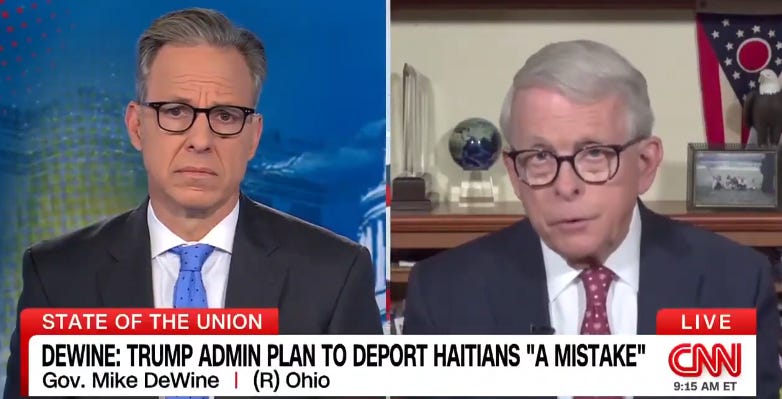
A couple of washed up and washed out Ohio Republicans took great umbrage:
Good Riddance to Bad Case Law
On Monday, SCOTUS handed the D.C. court another L—and in the process, the high court finally inflicted a death blow to Humphrey’s Executor, the SCOTUS decision that recently has been cited, unsuccessfully, by multiple presidential appointees fired by President Trump. (Brief explainer here.) In doing so, the justices re-established executive authority and disabused those who envision a non-existent fourth branch of government that operates “independently” of the Constitutionally-established three.
After the president removed her from the Federal Trade Commission last year, Biden-appointee Rebecca Slaughter filed a lawsuit to keep her position for the remaining six years of her term. Slaughter had argued the president did not follow Humphrey’s Executor guidance by failing to explain any “inefficiency, neglect of duty, or malfeasance in office” that prompted her firing.
In July 2025, D.C. Judge Loren AliKhan, another Biden appointee, reinstated Slaughter to the FTC, describing the commission as a “specially crafted independent agency.” (Her opinion is here.) Another 2-1 panel of majority Obama-appointed judges endorsed AliKhan’s view and denied the administration’s request to put a hold on her order. “The government has no likelihood of success on appeal given controlling and directly on point Supreme Court precedent,” Judges Patricia Millett and Cornelia Pillard wrote in July 2025. “Specifically, ninety years ago, a unanimous Supreme Court upheld the constitutionality of the Federal Trade Commission Act’s for-cause removal protection for Federal Trade Commissioners,” referring to Humphrey’s Executor.
Millett and Pillard were once again wrong. In another 6-3 decision, SCOTUS reversed the Democratic judges: “Although it is up to the Senate to decide whether to confirm those with whom the President would prefer to work, neither Congress nor the courts may saddle him with those with whom he cannot work,” Chief Justice John Roberts wrote for the majority. “Subordinates who exercise the President’s power are subject to removal by him. Then, and only then, can they remain accountable to the President, and the President to the people.” He continued. “If anything more is left of Humphrey’s, we overrule it. Humphrey’s has for decades been a result in search of a rationale.”
Sort of like the D.C. court system.
So, how many of these wrongheaded decisions will it take before Republicans act? The encroachment by the judiciary onto executive branch authority is most prevalent in Washington courtrooms; their decisions have drastically stymied the president’s agenda on a number of fronts including immigration, the federal workforce, the military, entitlement programs, and foreign affairs.
And no amount of SCOTUS reversals can get that stolen time back.
Julie, you pose a great question, the Republicans are all about hearings which result in no action. They seem to be doing snap shots and sound bites (Dan Bongino term) to make us think they are doing the will of the people. Reminds me of the Save America Act which 80% of the voters favor. Our Judicial System has become tainted by appointed political activist, their rulings are made according to who appointed them. What is very troubling I think it is only going to get worse as the unelected Judges will rule along party lines and by their TDS, since there are no repercussions when over ruled by the SCOTUS. There are several Judges who were appointed by Trump waiting to be approved by the Senate, the Senate Majority Leader, I use the term leader loosely , continues to stall and hold up these nominations, which I call disgraceful.
Thanks for this brief update, Julie. These two decisions released today indicate that there might be hope, still, that this judicial coup will end soon. But, then, you see what that idiot Chief Justice did in the "mail-in-ballot" decision and you realize that all is not what it seems...