
This is a guest column by Dr. John Eastman, a Senior Fellow at The Claremont Institute, and former longtime professor of constitutional law.
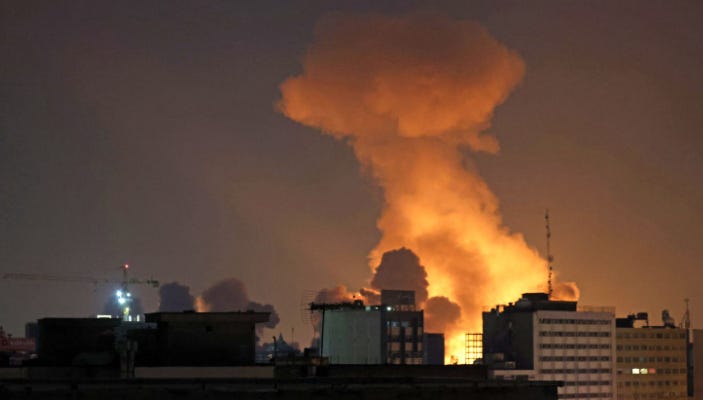
It has been a little over a week since U.S. military forces, acting pursuant to direct authorization from President Donald Trump as Commander-in-Chief, began a large attack, coordinated with Israeli military forces, on the Islamic Republic of Iran.
The Islamic Republic’s top leadership, including Supreme Leader Ayatollah Ali Khamenei, have been killed, its navy entirely destroyed, its air defense systems decimated, and much of its ability to counterattack severely (though unfortunately not entirely) undermined. Freedom-loving Iranians the world over, both inside and outside the country, have been exuberant at the prospect of restoring their beloved country to the ranks of respected, peaceful, and prosperous nation states.
One would think that such a potentially transformative action would draw praise from both sides of the political aisle in the United States. Iran, after all, has been the leading state sponsor of terrorism ever since its current ruling junta took control in 1979. That’s 47 years of terrorist attacks against the United States (which it describes as the “Great Satan”), our key ally in the Middle East Israel (“Little Satan”), and others. And the Islamic Republic has made clear, repeatedly, that it intends to acquire nuclear weapons and to use them. A decisive effort to put an end to this ongoing threat is therefore long overdue and should be applauded.
Alas, not so. Prominent voices on both the left and the never-Trump or isolationist right are crying “foul,” claiming that the President had no legal authority for these actions. Only Congress has the constitutional power to declare war, they contend, and absent that or some specific statute authorizing the use of force, the President is impotent to respond to the ongoing threat that the Islamic Republic posed.
Presidential Authority in Such Matters Dates Back Centuries
Never mind that throughout our nation’s history, as thoroughly described in a 2014 report by the Congressional Research Service, Presidents have relied on their own constitutional authority to deploy the military in response to threats from abroad. Thomas Jefferson’s deployment of the U.S. Navy and Marines in 1801 to fight the barbary pirates before any authorization for the use of force by Congress, memorialized in the “to the shores of Tripoli” line in the Marine Corps’ hymn, is a famous example.
In fact, of the nearly 500 deployments of the military into conflict or potential conflict, only five (which cumulatively included 11 declarations) have involved formal declarations of war by Congress—and none since the Second World War. Another 150 or so can be tied to the 12 statutory authorizations for the use of force that Congress has approved (such as the Gulf of Tonkin resolution in 1964, albeit years after Presidents Truman, Eisenhower, Kennedy, and Johnson had successively deployed U.S. troops to Vietnam), but that still leaves about 300 military actions undertaken on the President’s constitutional authority alone. Given the Islamic Republic’s 47-year history of attacks against the United States, that authority and precedent is more than sufficient, particularly in light of credible evidence, among other things, that Iran has been working on nuclear warhead adaptations for nosecones of its ballistic missiles.
But there is statutory authority as well.
Most of the commentators, pro and con, have focused on the War Powers Resolution adopted by Congress in 1973. Although every president since has contested its constitutionality, most have nonetheless complied with its terms. Perhaps the most notorious example to the contrary was Operation Odyssey Dawn, authorized by President Obama against Libya in 2011 despite acknowledgement that there was no imminent threat against the United States or its allies. That military action resulted in the overthrow and death of longtime Libyan dictator Muammar Gaddafi but also prolonged civil war and instability in the region and is generally viewed as a massive strategic failure. State Department Legal Advisor Harold Koh laughably contended that Congress’s War Powers Resolution, which requires the withdrawal of troops from hostilities after 60 days, did not apply because Libya really had no ability to engage in “hostilities” against U.S. forces in response to U.S. attacks, including drone strikes.
The WPR purports to allow the President’s exercise of his constitutional powers as Commander-in-Chief “only pursuant to 1) a declaration of war, 2) specific statutory authorization, or 3) a national emergency created by attack on the United States, its territories or possessions, or its armed forces.” It requires the President to consult with Congress “in every possible instance … before introducing” U.S. forces into hostilities, and absent a declaration of war, to submit a written report to congressional leaders within 48 hours after the deployment explaining the circumstances that necessitated the deployment, the constitutional and legal authority for it, and the estimated scope and duration of the engagement. The use of the military must be terminated within 60 days (or an additional 30 days if the President certifies such is necessary to protect the safety of US troops in effective a prompt removal of them from hostilities) unless Congress has in the interim declared war or passed a specific statutory authorization.
Trump Followed Federal Law in Launching the Attack
The first claim that President Trump violated the WPR was the contention that he did not consult with Congress before the attacks began. That quickly unraveled when it was revealed that Secretary of State Marco Rubio had in fact brief the “gang of eight” leadership in Congress prior to the attack.
The next claim of violation is based on the contention that there was no imminent threat to the United States, and hence the third statutory trigger was not met. Yet there have clearly been numerous attacks by Iran and its proxies against the United States, its territories (including its embassies), and its military over the past 47 years. That those attacks have largely gone unanswered by prior administrations does not eliminate the fact that they were attacks.
As The Hill newspaper recently summarized, they have included the 1983 suicide car bombing of the U.S. Embassy in Beirut, Lebanon (killing 63), the October 1983 truck bomb at a Marine barracks in Beirut (killing 220 US Marines and 21 other service personnel), the June 1996 attack on the U.S. Air Force housing complex, Khobar Towers, in Khobar, Saudi Arabia (19 American deaths, 500 people injured), the August 1998 attacks on U.S. Embassies in Kenya and Tanzania (224 dead, thousands wounded), the January 2020 Iranian missile attack on U.S. forces at the Ain al-Asad airbase in Iraq (more than 100 U.S. troops with traumatic brain injuries), and, as documented in a recent report by the Foundation for the Defense of Democracies, more than 180 attacks against U.S. forces between October 2023 and November 2024 (more than 180 wounded, 3 killed).
Perhaps the claim is that these were not “emergencies” because they happened a while ago. But as recently as last June, three U.S. bases in Syria and two in Iraq were attacked with missiles or drones, likely by Iranian-backed militias. One is left to wonder when the naysayers would consider that the cumulative impact of this long string of attacks against U.S. Embassies and military personnel would rise to the level of “emergency” triggering the use of force under the WPR.
But that is not the only statutory authority. The second category that authorizes the President’s use of force under the WPR is “specific statutory authorization,” and there is one, although most commentary on the present conflict omit it.
It is the 2001 Authorization for the Use of Military Force (AUMF), enacted in the immediate aftermath of the 9/11 attacks. It authorizes the President “to use all necessary and appropriate force against those nations, organizations, or persons he determines planned, authorized, committed, or aided the terrorist attacks that occurred on September 11, 2001, or harbored such organizations or persons, in order to prevent any future acts of international terrorism against the United States by such nations, organizations or persons.”
That’s pretty broad – if, that is, Iran had anything to do with the 9/11 attacks. Here, we don’t need to rely on a presidential determination, as a federal court in New York already found, in a thorough 2011 opinion with 276 separate findings of facts based on well-document sources and sworn expert affidavits, that the Islamic Republic of Iran provided “material support and resources to al Qaeda for acts of terrorism” generally. Even more significantly, the Court held that the Islamic Republic of Iran “provided direct support to al Qaeda specifically for the attacks on the World Trade Center, the Pentagon, and Washington D.C. (Shanksville, Pennsylvania), on September 11, 2011.”
Such support included “planning, funding, facilitation of the hijackers’ travel and training, and logistics, and included the provision of money, lodging, training, expert advice or assistance, safehouses, false documentation or identification, and/or transportation.” held the Court. The Court’s decision in the case, Havlish v. Usama Bin Laden et al. (aka In re Terrorist Attacks on Sept. 11, 2001), 2011 WL 13244047 (S.D.N.Y. Dec. 22, 2011), is readily available here. The several expert affidavits are also available at Court Listener—the one by former CIA Directorate of Operations officer and counterintelligence specialist Clare Lopez is particularly enlightening.
Why is it important to rely on the AUMF instead of just the WPR itself? The latter’s 60-day limitation on the use of armed forces provides a huge incentive to the Islamic Revolutionary Guard Corps and what remains of the religious and secular leadership in Iran to hold out until the U.S. has to withdraw its forces.
While we all hope and expect that President Trump’s prediction that this conflict will be resolved in weeks rather than months or longer is correct, it is simply folly to provide the enemy with a date certain for withdrawal. The AUMF has no such end date and therefore removes any last-gasp holdout incentive for the dying regime.
It is really hard to believe people on the Left and Democrats in Congress hate the President more than they love their country. Rooting for our brave military to fail is the most despicable act ever in the history of our nation. They want Donald Trump to fail! I cannot understand anyone putting their hatred for one man over our great nation. I am still in awe why there are people who still vote for them!!
Hellos 👋 MISS JULIE KELLY 🇺🇲⚖️⚖️⚖️🇺🇲
This note 📝 NEEDS TO BE SENT AND READ TO CONGRESS 👀 PUT SOME FIRE 🔥 UNDER THEIR SEATS FOR CONCERN AND COMMEN SENSE WITH A REMINDER WHO WE THE PEOPLE STAND FOR 🇺🇲
THIS IS ABOVE JUST A GREAT ARTICAL WRITTEN......!!!!!
THANK YOU MISS JULIE KELLY MAGA 🇺🇲⚖️⚖️⚖️🇺🇲🦅🗽💯💪😎✝️❤️🤍💙🌹