

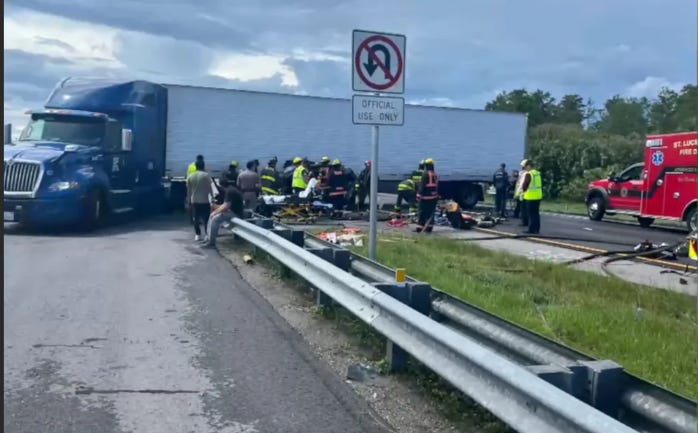
One of the more consequential achievements of the Trump administration is the rewriting of federal law strictly limiting who is allowed to get behind the wheel of an 80,000-pound semi trailer truck and drive on America’s roadways. A series of fatal crashes in 2025 and 2026 exposed the largely unknown practice of foreigners, many here illegally, obtaining what’s called “non-domiciled” commercial driver’s licenses (CDLs) in several states.
Most of those states now are following the lead of Transportation Secretary Sean Duffy, who last year proposed new federal guidance that prohibited states from issuing CDLs and commercial learner’s permits to a broad range of immigrants. Last week, the state of Indiana revoked all non-domiciled CDLs; those drivers must obtain one of three visas identified in Duffy’s new guidance. Non-domiciled CDL holders in the Hoosier state must also demonstrate proficiency in English; companies who knowingly hire a foreign truck driver without the proper documentation will face a $50,000 fine.
Idaho revoked its entire non-domiciled CDL program in March. Tennessee lawmakers are considering legislation that would make it a crime for an illegal immigrant to hold a CDL and would allow Tennesseans injured by an illegal truck driver to sue their employer for damages.
While states are codifying, even expanding on, Duffy’s successful efforts to take CDLs out of the hands of unqualified immigrant drivers, a D.C. appellate court may once again undermine his plans.
Duffy introduced an emergency interim rule last September that drastically reduced the category of immigrant drivers eligible to receive CDLs; the emergency action came in response to what Duffy described as the “disturbing” results of a nationwide audit that revealed many states were not following federal law in issuing non-domiciled CDLs. At least 25 percent of non-domiciled CDLs in California and at least 20 percent of non-domiciled CDLs in Illinois had been issued unlawfully.
But a few months later, in a 2-1 decision, the D.C. court of appeals put a hold on that emergency rule. In response to a lawsuit filed by labor unions and a few truck drivers impacted by the new rule, the court ruled in November 2025 that the Department of Transportation had not “demonstrated any safety benefit from the rule” and that the agency had acted “arbitrarily and capriciously.” But after the required public comment period ended in February, the rule—published by the DOT’s Federal Motor Carrier Safety Administration—became final on March 16.
At least for now.
Will Democratic Judges in D.C. Once Again Torpedo a Popular Policy Because Trump?
The same litigants are asking the D.C. appellate court to halt ongoing implementation of the final rule, which could result in the revocation of at least 200,000 non-domiciled CDLs across the country. In a filing last month, two labor unions—the American Federation of State, County and Municipal Employees and the American Federation of Teachers—demanded an expedited schedule on the matter, claiming irreparable harm to the disqualified haulers. “There is a strong and compelling public interest in expeditious review of the Rule, which threatens to destroy the livelihoods of the individual driver Petitioners, numerous members of the union Petitioners, and tens of thousands of drivers across the country,” they wrote. “The Rule also threatens harm to numerous families, employers, schools, and local and state governments that depend on the work of commercial drivers.”
Duffy responded by arguing the best interest of the public, not the unlawful drivers, is at risk if the court blocks the rule. “”As a baseline matter, an order prohibiting the government from complying with its statutory mandate to ensure safe operation of commercial motor vehicles inflicts per se irreparable harm,” the Department of Justice wrote on behalf of the DOT. On Monday, Duffy’s office submitted a 546-page document listing all records related to the implementation of the rule, including thousands of comments made by the public—many with foreign-sounding last names, presumably opposed to the rule—in accordance with federal law.
The D.C. appellate court has not yet responded to the latest filings but the judges on the panel don’t exactly instill confidence that the rule will remain intact. Judge Florence Pan is on the existing three-judge panel overseeing the case; she also sat on the panel last November that put the brakes on the emergency rule. (Pan also is married to a longtime Democratic activist who is opposing the president’s plans to reduce the federal workforce.) Judge Cornelia Pillard, an Obama appointee and frequent thorn in the president’s side, also sits on the panel.
Duffy’s attention to the significant danger posed by unqualified, illiterate, and in many instances, illegal immigrants sitting behind the wheel of semi trailer trucks has garnered nationwide, and even bi-partisan, support. Sadly, that means nothing to the hyper-partisan judges in the nation’s capital working hand in hand to sabotage the president’s policy goals—even if it means keeping dangerous drivers on the roads. There is a slim chance the judges will do the right thing and allow the popular rule to remain in place; but it is more likely another hit job against the administration is incoming.
A decision is expected sometime this month.
What in blue blazes does the teachers union have to do with CDL licenses? My guess is nothing they're just following Soros anti-Trump orders.
Maybe just this one time the appellate court can do what is right, make this about saving lives and not about hating Trump. We can only hope they have enough sense to make the only decision that should be made.